by Chris
There are many lists out there. Some lists have "The Godfather" as the best movie of all time, but those lists also have "The Empire Strikes Back", "Pulp Fiction", ", Schindlers List" etc in the Top Ten, ignoring older movies. Other lists have "Citizen Kane", "Casablanca", "On the Waterfront", "Lawrence of Arabia", "Singin' in the Rain" and "Gone with the Wind" etc in the Top Ten clearly ignoring some significant, more recent movies.
Bottom line is everyone has their own list of Best Movies of all time...here is another one of mine :

11 February 2008

08 February 2008
05 February 2008
The Glory of Rome
by Chris

SPQR - Senātus Populusque Rōmānus ("The Senate and the Roman People")
(if the music hasnt started yet, press play on the mp3 player to the right)


If you like this kind of stuff ( I do) , you could spend all day in the Vatican musuem ! (we did!)

Up on the Palatine Hill...more ruins and architectural goodies
The Colosseum !

Finished in 80 AD., the largest ampitheatre ever built in the Roman Empire.
 Originally capable of seating around 50,000 spectators, the Colosseum was used for gladiatorial contests and public spectacles. It remained in use for nearly 500 years with the last recorded games being held there as late as the 6th century. As well as the traditional gladiatorial games, many other public spectacles were held there, such as mock sea battles, animal hunts, executions, re-enactments of famous battles, and dramas based on classical mythology.
 I can only imagine what it was like...waiting to enter the Colosseum.

 The Baths at Caracalla were the inspiration for many modern buildings including Penn Station in New York.
 For more - The Baths of Caracalla
One of the best preserved & most impressive sights in Rome:
The Pantheon

 Oculus is the Latin word for eye and the name of the round opening in the top of the dome of the Pantheon. It has always been open to the weather, allowing rain to enter and fall to the floor, where it is carried away through drains.


One of the ever present monuments to Roman power, the city walls and gates.


SPQR - Senātus Populusque Rōmānus ("The Senate and the Roman People")
(if the music hasnt started yet, press play on the mp3 player to the right)

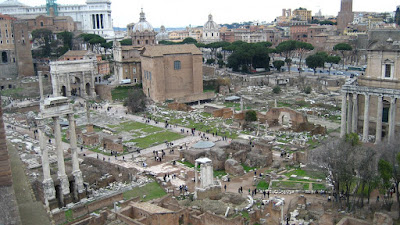
The Roman Forum is located in a valley that is between the Palatine hill and the Capitoline hill. It originally was a marsh, but the Romans drained the area and turned it into a center of political and social activity. The Forum was the marketplace of Rome and also the business district and civic center. It was expanded to include temples, a senate house and law courts. When the Roman Empire fell, the Forum became forgotten, buried and was used as a cattle pasture during the Middle Ages.

Much of the forum has been destroyed. Columns and stone blocks are all that remain of some temples. The arch of Titus and the arch of Septimius Severus still stand and are in good shape. Like many other ancient Roman buildings, stone blocks have been removed from the Forum and used to build nearby churches and palaces.

The arch of Titus is located at the opposite end of the forum from the arch of Septimius Severus. Titus was the emperor that had sacked the great Jewish temple in Jerusalem. The arch was built in his honor. Sculptures on this arch show the treasure of the Jews being taken through the streets of Rome. On the inside of the left leg of this arch, there is a well known sculpture of Romans carrying away a Jewish menorah. (below)
 Everywhere you go in Rome you are reminded of the power and wealth of the Roman Empire.
 Everywhere you go in Rome you are reminded of the power and wealth of the Roman Empire.
The 10ft head of Augustus Caesar from what must have been a gigantic statue.

If you like this kind of stuff ( I do) , you could spend all day in the Vatican musuem ! (we did!)

Up on the Palatine Hill...more ruins and architectural goodies
The Colosseum !

Finished in 80 AD., the largest ampitheatre ever built in the Roman Empire.
 Originally capable of seating around 50,000 spectators, the Colosseum was used for gladiatorial contests and public spectacles. It remained in use for nearly 500 years with the last recorded games being held there as late as the 6th century. As well as the traditional gladiatorial games, many other public spectacles were held there, such as mock sea battles, animal hunts, executions, re-enactments of famous battles, and dramas based on classical mythology.
 I can only imagine what it was like...waiting to enter the Colosseum.
The Baths of Caracalla - The largest baths in Rome

The bath complex covered approximately 13 hectares (33 ac). The bath building was 228 meters (750 ft) long, 116 meters (380 ft) wide and 38.5 meters (125 ft) estimated height, and could hold an estimated 1,600 bathers

The bath complex covered approximately 13 hectares (33 ac). The bath building was 228 meters (750 ft) long, 116 meters (380 ft) wide and 38.5 meters (125 ft) estimated height, and could hold an estimated 1,600 bathers
 The Baths at Caracalla were the inspiration for many modern buildings including Penn Station in New York.
 For more - The Baths of Caracalla
One of the best preserved & most impressive sights in Rome:
The Pantheon

Above, the truly breathtaking pediment and columned portico of the Pantheon, built in 27BC destroyed and rebuilt in 125AD
 Oculus is the Latin word for eye and the name of the round opening in the top of the dome of the Pantheon. It has always been open to the weather, allowing rain to enter and fall to the floor, where it is carried away through drains.
Pantheon means "Temple of all Gods", it pre-dates Christianity in Rome and is considered the best preserved building of its age in the world.
Below, the ruins in the Jewish Ghetto of Rome. There has been a Jewish community in Rome since the 1st century B.C.
Below, the ruins in the Jewish Ghetto of Rome. There has been a Jewish community in Rome since the 1st century B.C.

One of the ever present monuments to Roman power, the city walls and gates.

Rome is a fascinating place to visit for anyone. It is impossible not to be impressed by the Glory that is Rome.

I, Keano


Kelly & I recently went to a show at the Olympia Theater with friends Michael & Patrice (of camping blog post fame). The play involves possibly the biggest sports related controversy in Ireland, the Saipan incident of the 2002 World Cup. Since I am new to the whole football (soccer) scene, UCD political lecturer & Irish sports expert Michael Kennedy was kind enough to do the honors of reviewing the show and giving us the background behind the controversy.
I, Keano – He Came, He Saw, He Went Home
by guest blogger - Michael Kennedy, University College Dublin
Irish sport and Irish society more generally have always been inextricably linked. Public discourse and public morale eternally vacillates in accordance with the trials and tribulations enjoyed or suffered by our sporting teams and their heroes. Whether it be the counties contesting the All-Ireland hurling or gaelic football championships, or the national rugby or soccer teams. In fact, some theorists of the Irish phenomenon known as the Celtic Tiger postulate that the economic boom associated with it was intimately tied to the surge of cool and confidence which emerged from a hugely successful campaign for the Irish soccer team in the 1990 World Cup Finals in Italy, where a Packie Bonner save in a penalty shoot-out against Romania put Ireland through to the quarterfinals (where they lost narrowly to Italy). Since then, Irish soccer has dared to believe that it might be entitled to be considered amongst the top soccer teams in the world, a point proved perhaps in the 1994 World Cup Finals in the USA where Ireland defeated Italy, their previous conquerors, by a score of 1-0 courtesy of a spectacular Ray Houghton goal at a packed Giants Stadium. Following this, however, the standards that the team had set for itself, and for the Irish public in general, began to slip. After failing to qualify for the 1996 European Championships, manager Jack Charlton was replaced by one Mick McCarthy (a former player). McCarthy was unable to lead the Irish team to the next World Cup Finals in France in 1998, but after a truly challenging qualifying campaign where Ireland was pitted against the likes of world soccer powerhouses Portugal and Holland, and had to qualify via a two-legged playoff against Iran, they were able to once again join the global elite for the 2002 World Cup Finals jointly hosted by Japan and South Korea. And much of the success along the path to that tournament was down to the skill, drive and determination of the national team captain – Roy Keane.
Roy Keane is a native of Cork City, County Cork (ever-so-appropriately known as The Rebel County). After playing for Cobh Ramblers in Cork and Nottingham Forest in England, Keane was signed by Manchester United in 1992. His spell at Manchester United lasted until 2005 and corresponded to the most successful period in the club’s history (under the tutelage of manager Alex Ferguson). This period included 8 Premier League titles, 5 FA Charity Shields, 4 FA Cups, 1 Intercontinental Cup, and the 1999 European Cup in the 1998-1999 season which saw Man United win a historic treble of Premier League, FA Cup and European Cup in the same season. Throughout the course of his illustrious playing career for his club, one performance in particular in that 1998-1999 season epitomised the type of player and person that Roy Keane was. In the semi-finals United were pitted against Italian giants Juventus, and found themselves behind within the first 15 minutes through two goals from Filippo Inzaghi. Keane, however, dragged his team back into contention with an outstanding glancing header from a corner kick to put the scoreline at 2-1 to Juventus. Shortly after his goal, however, Keane was yellow-carded for a tackle on Zinedine Zidane, and as a result of this card would miss the final if his team were to win and progress. Rather than crumble at this prospect (some may remember England player Paul Gascoigne bursting into tears when put in a similar position playing for England in the 1990 World Cup semi-final), Keane worked twice as hard to ensure that his team made it to the final even if he himself did not. His manager Alex Ferguson described Keane’s performance in this way – “It was the most emphatic display of selflessness I have seen on a football field. Pounding over every blade of grass, competing if he would rather die of exhaustion than lose, he inspired all around him. I felt it was an honour to be associated with such a player.” United went on to score two further goals to win the game 3-2, and subsequently won the European Cup Final against Bayern Munich.
To say that Keane was known as an abrasive character would be an understatement. He demanded the best of himself, but also others (including players, and even fans), in an almost pathological way. Some notable contributions have included comments on Man United fans, some of whom had been spoilt by success - "Away from home our fans are fantastic, I'd call them the hardcore fans. But at home they have a few drinks and probably the prawn sandwiches, and they don't realise what's going on out on the pitch. I don't think some of the people who come to Old Trafford can spell 'football', never mind understand it.” In 2001, Keane was at the centre of controversy when, in a game against bitter rivals Manchester City, he targeted an opposition player named Alf-Inge Haaland who had previously accused Keane of feigning injury when they tangled in a game during the 1997-98 season which left Keane with a serious cruciate ligament injury (for footage of both incidents, see http://www.youtube.com/watch?v=fJuxKrnTP-k ). Keane was roundly condemned for this blatant act of revenge, and criticized further when describing the incident in his autobiography in this way – “I’d waited long enough. I f*cking hit him hard. The ball was there (I think). Take that you c*nt. And don’t ever stand over me sneering about fake injuries.” This attitude increasingly pervaded Keane’s on and off the field personality, and emerged again, with disastrous consequences, in the build-up to the 2002 World Cup Finals.
The official (ie Wikipedia version!) of the events during the 2002 World Cup Finals are as follows – “The Football Association of Ireland selected the Pacific island of Saipan as the training base for Ireland's World Cup campaign. During the course of the first training session, Keane expressed serious misgivings about the adequacy of the training facilities and the standard of preparation for the Irish team. He was angered by the late arrival of the squad's training equipment, which had disrupted the first training session on a pitch that he described as "like a car park". This was made all the more frustrating by the fact that Mick McCarthy had promised Keane that he would eradicate the lackluster and unprofessional approach to training that had personified the Jack Charlton era. After a row with goalkeeping coach Packie Bonner and Alan Kelly on the second day of training, Keane announced that he wished to return home to Manchester due to his dissatisfaction with Ireland's preparation. McCarthy approached Keane and asked him to return to the training camp, and Keane was eventually persuaded to stay until the end of the tournament. Despite a temporary cooling of tensions in the Irish camp after Keane's change of heart, things soon took a turn for the worse. Keane gave an interview to leading sports journalist Tom Humphries, of the Irish Times newspaper, where he expressed his unhappiness with the facilities in Saipan and listed the events and concerns which had led him to leave the team temporarily. McCarthy took offence at Keane's interview and decided to confront Keane over the article in front of the entire squad and coaching staff. Keane refused to relent, saying that he had told the newspaper what he considered to be the truth and that the Irish fans deserved to know what was going on inside the camp. He then unleashed a stinging verbal tirade against McCarthy: “Mick, you're a liar... you're a f*cking wanker. I didn't rate you as a player, I don't rate you as a manager, and I don't rate you as a person. You're a f*cking wanker and you can stick your World Cup up your arse. The only reason I have any dealings with you is that somehow you are the manager of my country! You can stick it up your bollocks.” Niall Quinn observed in his autobiography that “Roy Keane's 10-minute oration [against Mick McCarthy, above] ... was clinical, fierce, earth-shattering to the person on the end of it and it ultimately caused a huge controversy in Irish society.” None of Keane's team-mates voiced support for him during the meeting, although some supported him in private afterwards. Veterans Niall Quinn and Steve Staunton backed McCarthy in a press conference after the event. It was here that McCarthy announced that he had dismissed Keane from the squad and sent him home.”
03 February 2008
Bobbie&BingoPalooza ends
by Chris

A funny story I remembered, on my last day of work in Tampa last year I came in to the office to find that Bingo had encased my mouse in jell-0....you silly bingo.

The first pint at Bruxelles...the bartender once again commented when I came in, "more visitors huh...two pints of Guinness coming right up"

Luckily, Mike's visit coincided with Rainbow week at Trinity College...here he is studying the schedule and seeing which events he wanted to participate in.

After 9 days or so, Bobbie & Bingo headed home today. We had an action packed vacation that included lots of stuff around Dublin and a trip to Paris..wooohooo! Kelly & Bobbie in Paris
 One night we took the ol' rickshaw ride from the top of Grafton Street to Temple Bar. Thats Kelly & I in the front rickshaw...Bingo was of course yelling at his driver to go faster the entire time...lol
 B&B at Glendalough
 Kelly & Bobbie in Paris
 One night we took the ol' rickshaw ride from the top of Grafton Street to Temple Bar. Thats Kelly & I in the front rickshaw...Bingo was of course yelling at his driver to go faster the entire time...lol
 B&B at Glendalough
It took lots of practice but Bingo mastered the art of leaving only 3 rings in his pint glass...here is one of his earlier attempts.

A funny story I remembered, on my last day of work in Tampa last year I came in to the office to find that Bingo had encased my mouse in jell-0....you silly bingo.

The first pint at Bruxelles...the bartender once again commented when I came in, "more visitors huh...two pints of Guinness coming right up"

Luckily, Mike's visit coincided with Rainbow week at Trinity College...here he is studying the schedule and seeing which events he wanted to participate in.

A great time was had by all.
More pics to be posted soon...for now, here is your video moment of zen
(2 videos below contain some foul language)
More pics to be posted soon...for now, here is your video moment of zen
(2 videos below contain some foul language)
Subscribe to:
Posts (Atom)